Shang Dynasty Bronze Gong Wine Ware

Shang Dynasty Bronze Gong Wine Ware

It's a ritual used to hold wine. It was mainly made during the reign of King Wu and King Zhao in the late Shang Dynasty (1300-1046 BC), and during the early Western Zhou Dynasty (1046-977 BC). Found in Anyang, this deep, boat-shaped wine-tipper demonstrates almost perfect craftsmanship. On the lower part of the handle and side are carved Taotie masks.
Western Zhou tripod

Western Zhou tripod

This relic is a tripod, a bronze vessel, and its ceramic prototype can be traced back to the Neolithic Peiligang culture. In the early Shang Dynasty (1600-1300 BC), bronze versions of the Pingzu Ding were cast. Ding is an ancient Chinese cooking or storage vessel, usually with two handles at the edge, supported by three or four columnar legs. The shape of the tripod is almost ubiquitous in China's early eras, including Neolithic ceramic vessels and Shang dynasty bronze vessels, as well as many later bronze and glazed pottery imitations. This artifact is in the collection of the Minneapolis Museum of Art.
Fang Ding from the Late Shang Dynasty

Fang Ding from the Late Shang Dynasty

This Fangding (food container) from the late Shang Dynasty in the 11th century BC is now in the collection of the Minneapolis Museum of Art in the United States. This square tripod, also known as the 'square tripod', showcases an interesting development in tripod design. Although it is still a square box shaped container standing on four columnar legs, the decoration shows a tendency towards abstraction, which may have been influenced by contemporary textile design.
Maitreya Buddha Stele

Maitreya Buddha Stele

This is an artwork created in 563 AD and is currently housed in the Minneapolis Museum of Art in the United States. Although this work is relatively small in scale, its exquisite carvings showcase the complete image found on larger Buddha statues. In addition to the Maitreya statue in the center, the engraved halo, and the bodhisattvas on both sides, flying heavens and dragons also appear on the flame shaped mandalas at the top and bottom. The back of the stone tablet is engraved with a 69 character inscription, which records the name of the donor who commissioned the production of this work and dedicated it in 563.
Buddhist Gatekeeper Stone Statue

Buddhist Gatekeeper Stone Statue

The statue of the gatekeeper god from the 8th century is now housed in the Minneapolis Museum of Art in the United States. This type of statue is usually located at the entrance of Buddhist cave sanctuaries and temple complexes, with the purpose of obstructing any forces opposing Buddhist thought. Therefore, they are vividly depicted as energetic postures, threatening facial expressions, exaggerated muscle structures, and ready to face all threats. The basic posture of this rare Tang Dynasty work, with its surrealism and complete plasticity, represents a style that had a huge impact on the Buddhist guardian image carved during the Kamakura period in Japan (1185-1333).
Standing Arhat, a statue in the Song Dynasty

Standing Arhat, a statue in the Song Dynasty

This Chinese cultural relic is a sculpture named "Upright Arhat", which is a Chinese work in the 6th century AD. This sculpture is currently housed in the Minneapolis Museum of Art in the United States.
Bronze vessels from the Eastern Zhou Dynasty, such as the Bronze Shengding

Bronze vessels from the Eastern Zhou Dynasty, such as the Bronze Shengding

This Chinese cultural relic is a bronze vessel called "Shengding", which was cast around 575 BC. Shengding "refers to a type of tripod with a flat bottom and a prominent waist. The word 'sheng' refers to the offerings provided within it. There are six Kui dragons climbing towards the lid in high relief around the body of the Ding. The surface is decorated with interwoven dragons, engraved with scale patterns, and overlapping feather like patterns. Although most of the decorations are made using traditional block casting bronze techniques, the six dragons, with their complex, perforated shapes, were individually crafted using the lost wax method. This cauldron is currently housed in the Minneapolis Museum of Art in the United States.
19th century Japanese ivory root sculpture "Mother of Ghosts Capturing Ghosts"

19th century Japanese ivory root sculpture "Mother of Ghosts Capturing Ghosts"

This artifact is an ivory root sculpture called "Ghost Mother Capturing Ghosts", created by a Japanese artist in the 19th century. This is a small Japanese root knot sculpture, usually made of ivory, used to decorate and secure the waistband of a kimono. It is currently housed at the Minneapolis Museum of Art in the United States. This piece depicts a ghost mother catching a ghost with a hat. Guizimu is a deity in traditional Chinese culture, believed to be the god who drives away ghosts. His image is usually depicted as a agile warrior holding a sword, with a stern face, chasing or capturing demons.
Bronze ware from the Shang Dynasty, known as the 'Bronze Pavilion'
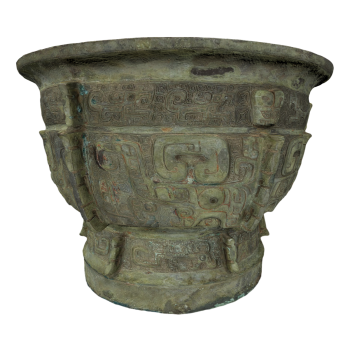
Bronze ware from the Shang Dynasty, known as the 'Bronze Pavilion'

This Chinese cultural relic is a wine vessel called "斝", produced in the 13th to 12th centuries BC. It is collected at the Minneapolis Museum of Art in the United States. 斝 is a ceremonial vessel used for ancestor worship, which is made of both pottery and copper. It can be quadrupedal or quadrupedal, with two cylindrical protrusions on the mouth edge, which may be used to hang the vessel above a heat source. Yan first appeared in the Neolithic Age (5000-2000 BC) and was very common in the Shang and early Western Zhou dynasties, but disappeared in the mid Western Zhou period.
Bronze vessels from the Western Zhou Dynasty, "Western Zhou Bronze Tripod"

Bronze vessels from the Western Zhou Dynasty, "Western Zhou Bronze Tripod"

This Chinese cultural relic is a tripod (food utensil) from the 12th to 11th centuries BC, currently housed in the Minneapolis Museum of Art in the United States. This tripod is a vessel designed by craftsmen during the Western Zhou Dynasty in the form of the Shang Dynasty. The main body of the tripod is a standard tripod, deep bowl shaped, while the circular handles on both sides are innovatively presented in the shape of elephant heads and trunks. Li is a type of food utensil in ancient China, mainly used for cooking and worship. This Li is a masterpiece from the Western Zhou Dynasty, with exquisite craftsmanship.
Guan Yu on horseback

Guan Yu on horseback

This is a 16th century artwork, currently housed in the Minneapolis Museum of Art in the United States. The statue is made of gold-plated bronze and measures 51.4 x 41.9 x 18.7 centimeters. Guan Yu (? -220 AD), also known as Yunchang and Changsheng, also known as Meiran Gong, Guan Gong, Wusheng, and Zhuangmu Hou, was born in Jiexian County, Hedong Commandery (now Jiezhou Town, Yanhu District, Yuncheng City, Shanxi Province). A famous general in the late Eastern Han Dynasty.
Lucky Beast (Foot End) Bronze Incense Burner

Lucky Beast (Foot End) Bronze Incense Burner

This cultural relic is one of a pair of lion incense burners, produced in the 17th century. Now collected at the Minneapolis Museum of Art in the United States. These lions look like guardian lions, known as auspicious beasts (Lu Duan), each with a unicorn. They are mythical animals endowed with the ability to distinguish between good and evil. These legendary animals appear in pairs and are used to stand on both sides of the imperial throne in the Forbidden City, symbolizing the dignity, virtues, and wisdom of the royal family. The size of this pair of incense burners is 57.2 x 33 x 61 centimeters, made of bronze and decorated with splashed gold.
Vietnamese vase, produced in the late 15th century
Vietnamese vase, produced in the late 15th century

This is a late 15th century artifact collected at the Minneapolis Museum of Art. Its decorative patterns include peonies, lotus flowers, birds, flowers, animals, fish, and even landscapes. These patterns are all painted in underglaze blue with a wavy background. The bottleneck is decorated with cloud vortices, there are banana leaves below the bottle mouth, and lotus leaves around the bottom of the bottle. The inspiration for Vietnamese blue and white porcelain comes from China. However, Vietnamese ceramic artists are not just imitators, they have developed a series of decorative patterns. This elegant pear shaped bottle is closely related to the Chinese prototype in both shape and decoration.
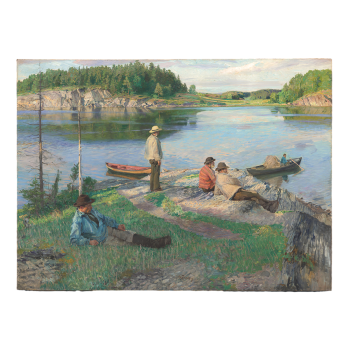
Salmon Fishermen of Neisse Island, created by Halima Elif Emmanuel Peterson
Salmon Fishermen of Neisse Island, created by Halima Elif Emmanuel Peterson

The oil painting "Laksefskere p å Nes ø ya" was created by Norwegian painter Hjalmar Eilif Emanuel Peterssen in 1891 and is currently housed in the Minneapolis Museum of Art. This painting depicts salmon fishermen resting on Nesser Island near the Norwegian capital Oslo. Peterson successfully combines the ideas and techniques of French Impressionism with traditional Scandinavian painting in this painting.
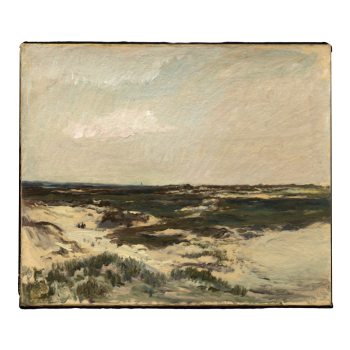
Camille Dunes of Dobigny, created by Charles Fran ç ois Dobigny

Camille Dunes of Dobigny, created by Charles Fran ç ois Dobigny

This oil painting titled 'Camille Dunes of Dobigny' was created by Charles Francois Dobigny. He was a painter of the Barbisson School in 19th century France and is considered an important pioneer of Impressionism. This painting depicts the scenery of Camille, a small town on the northwest coast of France. Dobini is known for sketching directly on canvas and adding multiple layers of color to create the final work. This aesthetic of sketching contributed to the emergence of the Impressionist movement. This painting was created in 1871 and can now be visited at the Minneapolis Museum of Art.
Christ in the Doctor "created by Luca Giodano

Christ in the Doctor "created by Luca Giodano

This oil painting titled 'Christ in the Doctor' was created by Luca Giodano. He was one of the most innovative and successful painters in Naples in the 17th century, with a large number of works and a unique style, full of the charm of the Baroque style, making him an international star. He had activities in Naples, Rome, Venice, and Florence, and served as a court painter for Charles II in Spain. Using typical Florentine style circular paintings, Giodano created a harmonious and dynamic composition with dramatic poses and vivid expressions. This painting can now be visited at the Minneapolis Museum of Art.
Bronze statue from the Sultanate of Delhi, India, depicting the Buddha's achievement without impurities
Bronze statue from the Sultanate of Delhi, India, depicting the Buddha's achievement without impurities

This statue, named the Pure Accomplishment Buddha, is one of the Five Wisdom Tathagatas in Tibetan Buddhism. It is related to the achievements of the Buddhist path and the destruction of poison. His name means' pure achievement '. His spouse is Tara, meaning the one who liberates, and his mount is Garuda. He belongs to the business family, whose family emblem is the Double Diamond Rod. This statue is made of copper and is currently housed in the Minneapolis Museum of Art in the United States. It was made in the 13th century AD, between 1200 and 1300 AD. This statue is a representative work of Tibetan Buddhist art, showcasing the artistic style and techniques of that period.
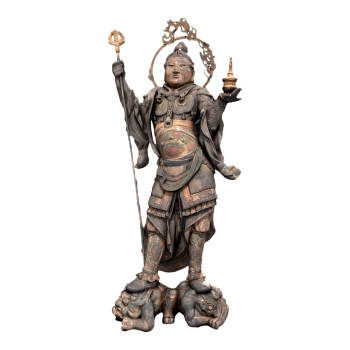
Minneapolis Museum of Art 13th Century Japanese Wood Carving Northern Heavenly King Vishamon Sky

Minneapolis Museum of Art 13th Century Japanese Wood Carving Northern Heavenly King Vishamon Sky

This is a late 13th century statue of the celestial Visharman, now in the Minneapolis Museum of Art. This statue is made of Japanese cypress wood, painted with color, gold foil, metal. It was created by Chang Qing, a famous Japanese sculptor of Buddha statues. Pishaman day is one of the four kings in Buddhism, guarding the north, driving out demons and protecting the world. He wore a heavily armored samurai with a spear and a small tower.